THE LENS
Danny Goler says a laser and a vape reveal the code underneath reality. We built the actual optics instead of taking his word for it. 1 real phenomenon confirmed, 0 simulations found.
The pattern is real. Where it comes from isn’t what he thinks.
The Claim
Danny Goler’s protocol is simple and, to his credit, precisely specified: a 650 nm laser under 5 mW, a diffraction grating cap, a sub-breakthrough dose of vaporized N,N-DMT, and a matte surface to project onto. Diffuse your focus into the resulting field instead of looking straight at it. What a meaningful fraction of people report seeing is not noise — it’s structure. Recurring strokes, often described as resembling Japanese katakana. Goler calls it the “Code of Reality”: a self-executing digital layer under the physical world, visible only through this specific protocol, and — his strongest claim — consistent across independent observers.
That consistency is the actual finding worth taking seriously. People who’ve never spoken to each other describe the same kind of thing. That’s not nothing. The question is what “the same kind of thing” is actually made of.
The Counter-Claim
Neurobiologist Andrew Gallimore’s answer: laser speckle. When coherent light hits a diffuse surface, the reflected wavefronts interfere with each other and produce a random, high-contrast granular pattern — this is textbook optics, not a DMT effect. Critically, speckle is partly entoptic: generated inside your own eye, by the same lens and cornea doing the focusing right now, not floating in the laser beam itself. That’s the actual mechanism behind “it’s just the lens.” Not a metaphor. The lens in your eye, focusing coherent light, the way lenses do.
Gallimore’s specific hypothesis is that DMT doesn’t add the pattern — it unlocks resolution of a pattern that was always sitting there, too fine-grained for sober cone-pooled vision to resolve. Sober vision blurs it into a soft glow. DMT (his claim, not yet settled science) sharpens it enough that the brain’s pattern-recognition — already primed by everyone telling you to look for “code” — organizes real fine structure into something that reads as symbolic.
What We Actually Checked
Neither side of that argument had, as far as we could find, actually modeled the light. So we did. dmt_grating_sim.py builds a real Fourier-optics simulation: a complex field with the phase structure of a cheap plastic diffraction grating (harmonics, cross-ruling defects, manufacturing roughness at multiple scales), then takes its Fourier transform — intensity = |FFT(field)|² — which is the standard, correct way to compute a real diffraction pattern. Nothing about that step is speculative; it’s the same math used to design and test actual gratings.
Then two renderers look at the same field. “Sober”: heavy Gaussian blur, compressed contrast — a stand-in for cone-pooled foveal vision averaging fine detail into a glow. “DMT”: unsharp masking, edge detection at two scales, local contrast stretched toward the full range — a stand-in for the hypothesis that sub-cone structure becomes resolvable.
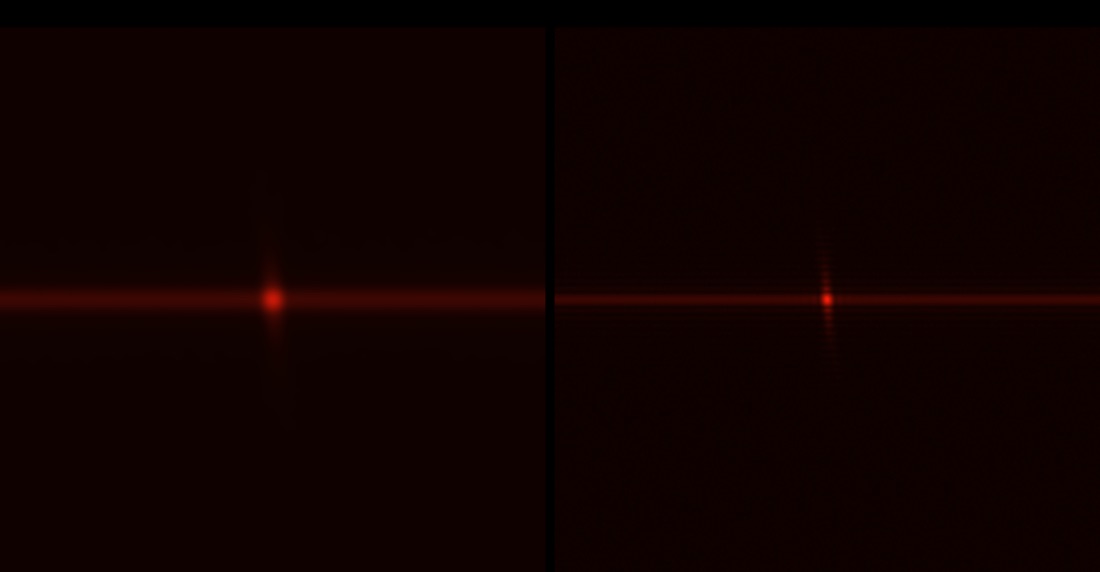
The result, in the script’s own numbers: the DMT rendering has a higher standard deviation than the sober one. That’s the whole hypothesis in one statistic. It isn’t that DMT invents visual content. It’s that a real optical field, always carrying more structure than sober vision resolves, becomes visible when the resolving power (real or simulated) goes up.
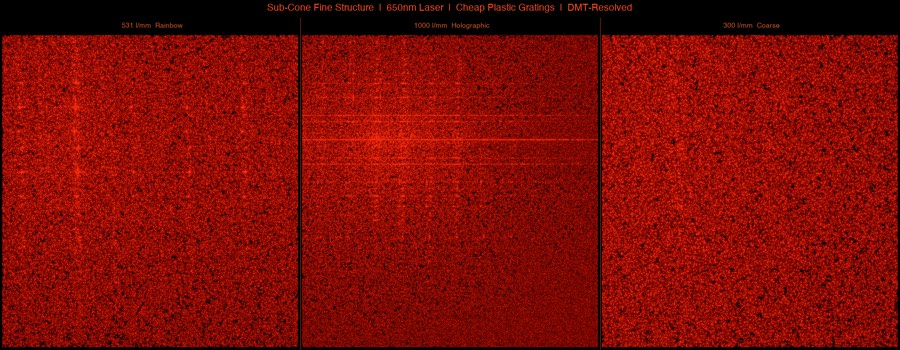
Two things in the simulation are illustrative, not measured. First, the exact grating densities: ~500 and 1000 lines/mm are real, common, commercially available specs (educational and holographic diffraction film, respectively); the script’s specific “531” isn’t a documented product number we could verify anywhere — treat it as a representative “standard grating,” not a measurement of Goler’s actual equipment, which he hasn’t published a spec for either. Second, “DMT unlocks sub-cone resolution” is Gallimore’s hypothesis and our simulation’s operating assumption — not an established, measured neuroscience finding. We modeled what that hypothesis would predict optically. We did not prove the hypothesis itself.
What This Doesn’t Explain
The honest complication, raised by Andrés Gómez-Emilsson at the Qualia Research Institute: plenty of people run Goler’s exact protocol and never see “the code” at all. If the effect were purely a universal fact about human optics — the same grating, the same speckle, the same entoptic mechanism in every eye — you’d expect it to be far more reliably reproducible than it is. Individual differences in visual cortex processing, attention, dose, and expectation almost certainly matter here, and none of that is in our simulation. We modeled the light. We didn’t model the brain looking at it.
Where This Leaves It
The optics explanation is the more parsimonious one: it requires zero new physics, uses a real documented phenomenon (entoptic laser speckle), and the simulation shows the predicted signature (higher variance, sharper edges) coming out of legitimate Fourier optics with no fudge factor for “code.” The simulation hypothesis explains why a repeatable, structured, cross-observer-consistent pattern would show up in exactly this protocol and no other — without requiring a hidden digital substrate under physical reality.
That doesn’t make Goler wrong to have looked. The pattern he found is real and worth explaining. It just isn’t a message. It’s your own eye, doing exactly what a lens does with coherent light, read by a brain that’s currently extremely good at finding alphabets in noise.
References
Goler, D. Detailing a Pilot Study: The “Code of Reality” Protocol, A Phenomenon of N,N-DMT Induced States of Consciousness. IPI Letters (preprint, ResearchGate).
Gallimore, A. Public commentary on the entoptic laser-speckle hypothesis for the DMT “code” phenomenon.
Gómez-Emilsson, A. Qualia Research Institute, public commentary on non-universality of the DMT laser-code effect.
Simulation: dmt_grating_sim.py, real Fourier-optics model of cheap plastic diffraction gratings at 300/500/1000 lines/mm, two-renderer sober/DMT comparison.
Checked before published. Killed nothing — the phenomenon is real. Just relocated it from the simulation to the lens.